
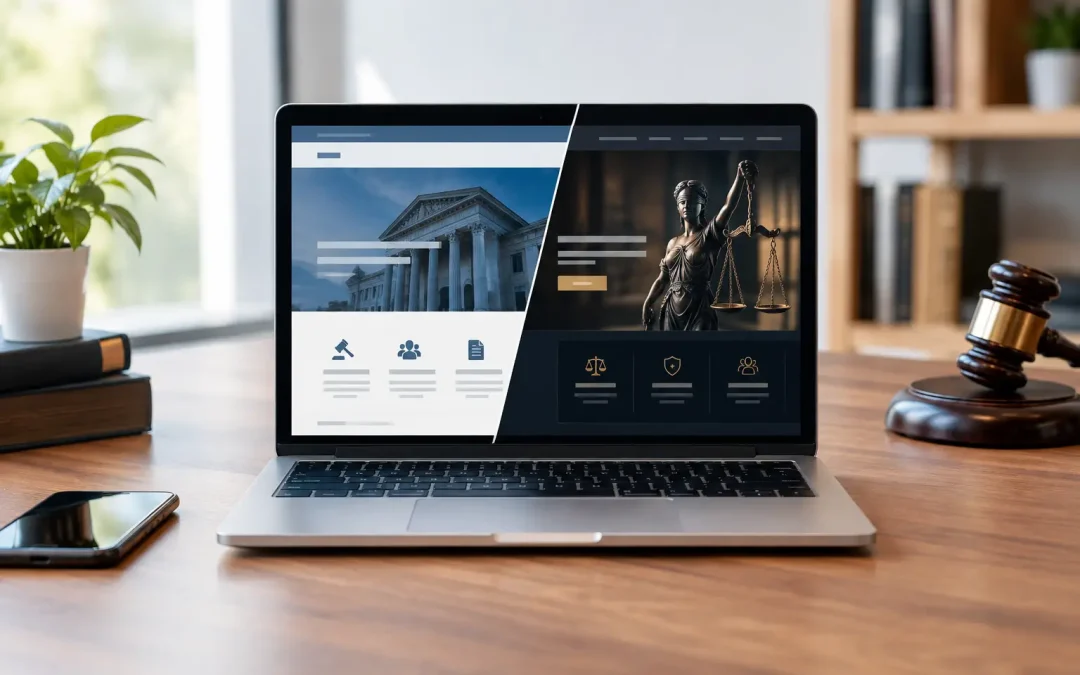
A law firm website is not a digital brochure. It is where a prospective client decides whether to call your office, submit a case evaluation, or keep searching. That makes the WordPress vs custom law websites decision a business decision, not a design preference.
For Canadian firms competing in personal injury, family law, immigration, employment law, or corporate services, the right platform must do more than look credible. It needs to rank in local search, load quickly on mobile, make contacting the firm easy, support ongoing content, and give your team control over the next marketing move.
The short answer is that WordPress is often the stronger option for growth-focused firms when it is properly planned, designed, secured, and maintained. A truly custom-built site can be the right investment in specific circumstances. The mistake is assuming that custom code automatically produces better results.
WordPress vs Custom Law Websites: The Real Difference
WordPress is a content management system. It gives your firm a structured way to publish and update pages, lawyer bios, practice area content, location pages, blogs, FAQs, and case results without rebuilding the site every time your marketing strategy changes.
A custom law website usually means one of two things. It may be a custom visual design built on WordPress, which can be an excellent middle ground. Or it may be a site developed from scratch on a proprietary framework or custom codebase. Those are very different products, even though both may be sold as “custom websites.”
A custom design on WordPress gives a firm a distinctive brand experience while preserving the flexibility of an established platform. A fully custom-coded website can give developers tighter control over every function and interface, but it may also create greater dependence on the original developer for updates, fixes, and new marketing pages.
The question is not, “Which platform is more premium?” The question is, “Which platform helps this firm acquire qualified cases efficiently over the next three to five years?”
SEO Is Usually the Deciding Factor
A law firm that wants better rankings needs to publish, improve, and expand content consistently. That could mean adding a Calgary employment lawyer page, strengthening a Toronto personal injury page, publishing answers to common immigration questions, or building detailed service pages around the cases the firm wants more of.
WordPress is built for this type of ongoing work. Its editor allows a marketing team to add pages, manage title tags and descriptions, organize internal links, publish articles, compress images, and keep content current. Those capabilities do not guarantee rankings, but they remove friction from the work that supports rankings.
A custom platform can support excellent SEO too. The problem arises when simple changes require a development ticket, a waiting period, and an extra invoice. If publishing a new practice-area page takes two weeks, your firm loses speed in a market where competitors are actively building local relevance.
Search performance also depends on technical execution. Page speed, mobile usability, crawlable navigation, structured page hierarchy, indexation controls, and clean redirects matter regardless of the platform. A poorly configured WordPress website will not outperform a well-engineered custom site simply because it uses WordPress. Conversely, an expensive custom build will not rank because it was built from scratch.
For most firms, the winning choice is the platform that makes quality SEO execution easier to maintain every month.
Local visibility needs flexible location content
Canadian legal searches are intensely local. Potential clients search for terms such as “family lawyer near me,” “wrongful dismissal lawyer Vancouver,” or “real estate lawyer Mississauga.” Your website must support the Google Business Profile, local service pages, reviews, directions, lawyer credentials, and clear contact details that reinforce local relevance.
That does not mean creating thin pages for every city in the province. It means building useful, original pages for the locations and legal issues your firm can genuinely serve. WordPress makes this content expansion practical. A rigid custom platform can make it unnecessarily expensive.
Lead Conversion Matters More Than Visual Novelty
Legal websites have one job: move the right visitor toward a conversation with your firm. A polished animation or dramatic homepage video may look impressive, but it has little value if a stressed prospective client cannot quickly understand what the firm does, whether it handles their issue, and how to get help.
A conversion-focused legal website needs visible calls to action, click-to-call functionality, short and secure intake forms, prominent practice areas, trust signals, lawyer profiles, office details, and fast-loading pages. It should also route inquiries into a process your team can manage. If leads sit unread in a generic inbox for two days, the platform choice becomes irrelevant.
WordPress supports this well through properly selected form, call-tracking, analytics, CRM, and scheduling integrations. The operative phrase is properly selected. Installing a collection of cheap plugins without a plan can create a slow, unstable website. Every integration should serve a measurable purpose: better lead capture, clearer attribution, stronger follow-up, or easier reporting.
Custom development may be worthwhile when your firm needs a highly specialized intake workflow. For example, a high-volume practice may require conditional forms, document collection, multilingual intake paths, automated eligibility screening, and integration with a proprietary case-management process. In that case, custom functionality can reduce administrative burden and improve the client experience.
Still, do not pay for custom functionality simply because it sounds advanced. Build it when the workflow is proven, the volume justifies it, and the feature will improve signed-case outcomes.
Ownership, Security, and Maintenance Need Straight Answers
Law firms handle sensitive inquiries. Website security is therefore not a minor technical issue. Whether you choose WordPress or custom development, your provider should explain who manages updates, backups, hosting, access permissions, malware monitoring, form security, and recovery if something fails.
WordPress is sometimes criticized because it is widely used and therefore frequently targeted. The real issue is neglected maintenance. A professionally managed WordPress site with reputable hosting, current software, limited plugins, strong access controls, backups, and monitoring can be highly secure. An abandoned custom website can be equally vulnerable, especially if its original developer is no longer available.
Ownership deserves equal attention. Ask who owns the domain, website files, written content, analytics accounts, conversion tracking, and design assets. Ask whether the site can be moved to another provider without rebuilding it. A custom proprietary system may appear efficient until you discover that leaving the vendor means losing years of content and paying for a new site from the ground up.
For a firm investing in long-term visibility, portability has real value.
When a Custom-Built Law Website Makes Sense
A fully custom build can be the right choice for a larger or operationally complex firm. It is particularly worth considering when the firm has established brand standards, significant traffic, unusual functionality requirements, multiple office workflows, or a client portal that cannot be handled reliably through existing tools.
It can also make sense when a firm needs exceptional performance at scale or has internal technology leadership capable of managing a custom environment. In those situations, the added development cost may be justified by operational gains.
But custom should not mean vague. Before approving the project, the firm should have a clear scope for content management, technical SEO controls, accessibility, analytics, call tracking, lead routing, security updates, ongoing support, and data ownership. If those answers are missing, the project is not custom strategy. It is custom risk.
The Best Choice for Most Canadian Law Firms
For solo lawyers, boutique practices, and established small-to-mid-sized firms, a custom-designed WordPress website is usually the strongest value-focused option. It combines professional design with marketing flexibility, supports regular SEO content, integrates with lead-generation tools, and avoids turning routine changes into development projects.
That recommendation comes with conditions. The site must be built around the firm’s practice areas, ideal client, geographic market, intake process, and growth goals. It needs purposeful messaging, not generic legal copy. It needs ongoing maintenance, not a launch-and-forget approach. And it needs reporting that connects traffic and rankings to calls, consultations, and retained matters.
The best website is the one your firm can improve quickly when search behaviour changes, a new service becomes profitable, or your intake team identifies a recurring client question. Choose the platform that gives you that momentum, then make sure every page earns its place by helping the right prospective client take the next step.